In 1906 Joseph Conrad published The Mirror of the Sea – a book of memories and reflections in which the twenty years he spent aboard sailing ships become an account of light, wind, anchors and the silence of the horizon. In Conrad, the sea is not a backdrop against which the action unfolds. It is a force that tests, and a space in which a person is left alone with themselves. It is this book that Simeon Stoilov has chosen as the starting point for his exhibition at Art Gallery Kazanlak, where audiences know him from the group exhibition Resurfacing (2025). The choice is no accident: the artist is a keen sailor and knows the sea not from the shore but from the deck – as wind, direction, fatigue and anticipation.
The new cycle is a natural continuation of a line that has run through Stoilov’s work for years. Already in his early exhibitions Island and Infinity, and later in Numinous and Nocturnes, contemplation proves to be not a theme but a method. An artist with a doctorate on art in space and the author of large-scale architectural projects, he thinks of the painting in a similar way – as an environment the viewer enters, not an object examined from outside. For him the image is not a finished form but a process that goes on happening before our eyes.
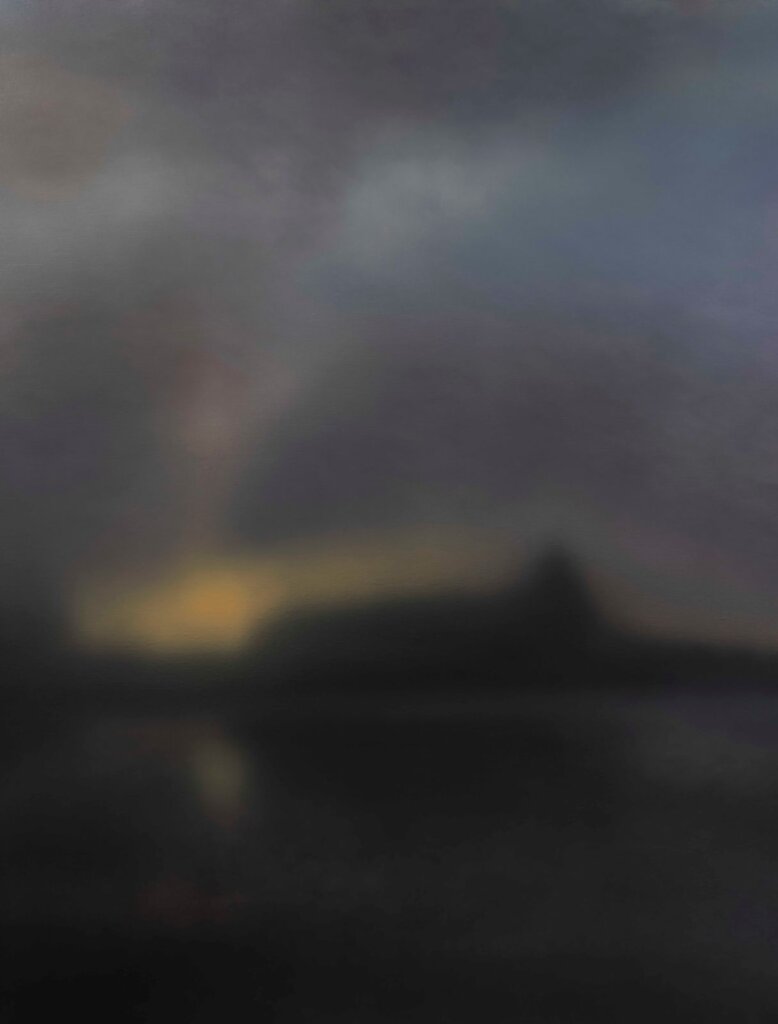
In The mirror of the sea this process is visible quite literally. The large canvases, some of which reach 150 × 200 cm, and the small formats of 60 × 50 cm are built from layered, blurred tones in which the representational gradually dissolves. What remains is the single constant of the seascape – the line of the horizon. Everything else happens above it: clouds grow heavy and tear apart, light breaks through as a vertical shaft, mist erases the boundary between water and sky. Sometimes the dark silhouette of a headland or an island surfaces in the distance; sometimes the horizon flares into a narrow scarlet strip of sunset. In one of the canvases a waterspout twists above the sea, and at its foot a small sail can barely be made out – almost a quotation from Conrad, in whom the human being is always measured against the scale of the elements.
The palette moves between cold blue, leaden grey and violet, through which warm pearly and ochre glints show. In the small works the violet and the inky tones sound almost musical – like variations on a single theme, in which every change in the light shifts the key.
The difference in scale is part of the exhibition’s design. The large canvases absorb the viewer and place them before the horizon as one sees it on the open sea – without support, without frame, without a point on which the gaze can rest. The small formats work more like entries in a ship’s log: brief, condensed observations of one hour, one gust of wind, one change in the colour of the water. Together they build the rhythm of a voyage in which the grand and the fleeting continually give way to each other.
Stoilov himself points to another parallel – Claude Debussy’s La mer. Curiously, Debussy’s three symphonic sketches and Conrad’s book appeared almost simultaneously, in the middle of the first decade of the twentieth century. Both works decline description in favour of a state: Debussy does not paint the sea in sound but builds the rhythm of the wave and the breathing of the air; Conrad does not tell of adventures but of experiences. Stoilov works in the same direction. His canvases do not show a specific place or a specific moment but time, atmosphere and change – what stays in the memory after long gazing at the water.
This painting can be linked to a tradition – from the atmospheric visions of J. M. W. Turner and the nocturnes of James Whistler to the blurred seascapes of Gerhard Richter. In Stoilov, however, it is free of romantic pathos and of conceptual distance. In their place there is silence, concentration and trust in slow looking. The absence of direct representation does not impoverish the image but opens it: viewers finish the picture themselves, with their own memories of the shore, of the wind, of the moment before the storm or after it.
And here the title reveals its deepest meaning. The mirror of the sea does not reflect the world as it is. It reflects the one who gazes into it – their anxiety, longing or calm. Simeon Stoilov’s paintings work in the same way. They do not tell us what to see; they leave us alone with the horizon. Perhaps this is the most valuable thing art can offer today: a space to pause in which, as in Conrad’s sea, a person once again feels how small they are – and how much their gaze can hold.