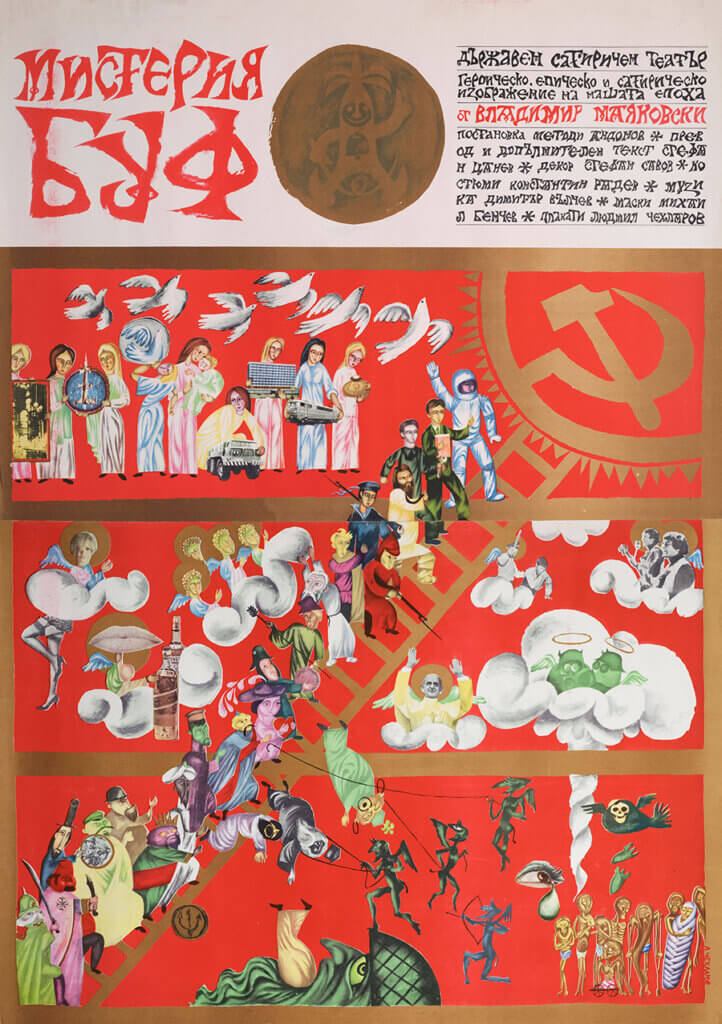
Wide Format is a series of exhibitions in which SOCMUS presents a single poster from its collection, along with the possible stories surrounding it. The third exhibition in the series is devoted to the poster created by artist Lyudmil Chehlarov for Vladimir Mayakovsky’s play Mystery-Bouffe, which premiered on 3 November 1967 at the State Satirical Theatre. The production was directed by Metodi Andonov, with the translation and additional text by the poet Stefan Tsanev.
Mystery-Bouffe was born of the October Revolution of 1917, one of the most turbulent moments in Russian history, when sweeping political change went hand in hand with a rethinking of art’s social role. Vladimir Mayakovsky—a leading figure of pre-revolutionary Russian Futurism who styled himself the poet of the future, of the people, of the revolution—wrote the play in 1918. It was staged in Saint Petersburg (then Petrograd) to mark the first anniversary of the revolution. Mayakovsky’s text entered into dialogue with the directorial experiments of Vsevolod Meyerhold and the avant-garde solutions of the artist Kazimir Malevich, who created the costumes and set. In the spirit of Futurism, Mayakovsky rejected the past, yet the play’s title and structure sit in tension with that very principle. “Mystery” refers to medieval European theatre and works staging biblical subjects, while “bouffe” denotes a popular comic genre in opera.
The biblical story of the Flood is transformed into a satirical parable about the destruction of the social order and the possibility of building a new world. At the centre of the plot stand two opposing groups; the Clean, symbolising the old order and capitalism, and the Unclean, who embody the working class. After a red flood suddenly breaks over them, the Clean and the Unclean set sail on a kind of Noah’s Ark, and their journey through Hell, Heaven and the Land of Chaos becomes a revolutionary odyssey. Rather than otherworldly salvation, the play’s ending leads them to the Promised Land, which the workers build for themselves. In 1921 Mayakovsky reworked the text to reflect the new reality following the Russian Civil War and the Bolsheviks’ final victory over their political opponents. The new version, again directed by Meyerhold, included references to current events such as the defeat of the White Army and Lenin’s newly introduced New Economic Policy (NEP). New villains were also added for the Bolsheviks — the prime ministers of France and Britain, Georges Clemenceau and Lloyd George.
The revolution, like Saturn, would devour its own children. Disillusioned by the state’s increasingly heavy-handed interference in artistic life, by official critics’ hostility towards his later work, and by crises in his personal life, Mayakovsky took his own life on 17 April 1930. Malevich’s Suprematism was denounced, Meyerhold’s theatre was shut down, and the director himself was executed in 1940.
In 1967, one of the most progressive stages of its time—the State Satirical Theatre in Sofia—rehearsed Mystery-Bouffe. The ideological framework of the time required theatres to mark the approaching 50th anniversary of the October Revolution with a production. Metodi Andonov and Stefan Tsanev used the occasion to bring the play into the theatre’s repertoire. Despite its propagandistic character, Mystery-Bouffe retains the dynamism of Mayakovsky’s poetic language and uses absurdity as a means of expression. The play fits into the climate of “thaw” following the April Plenum, which allowed the formulaic conventions of Socialist Realism to be loosened within moderate limits.
At that point, Mayakovsky was known in Bulgaria chiefly for his propagandistic revolutionary poetry. Stefan Tsanev encountered Mayakovsky’s early Futurism while studying in Moscow in the 1960s — an encounter that left a lasting impression on him. The extraordinary story of the communist flood that engulfs the world was translated by Tsanev himself. In his work on the stage adaptation, the playwright adhered to Mayakovsky’s own instruction to freely adapt the text to the present day.
As Lyudmil Chehlarov recalls, the director Metodi Andonov showed him a reproduction of an icon as a visual model for the future poster. In this way, the director’s concept and the artist’s solution converged on the idea of recreating an iconographic scheme. A twelfth-century Byzantine icon depicting the Ladder of St John Climacus would serve as the basis for the visual reimagining of the path to the communist paradise.
The poster bombards us with dozens of painted and photocollaged figures climbing the ladder. But instead of Christ, what awaits them in blessing is the Soviet communist symbol; the hammer and sickle. Fragments of the Cold War saturate the poster’s various registers. The upper section, with the Promised Land, is reserved for the Unclean—the builders of the communist utopia—and for symbols of technological achievement and the Space Age. At the top of the ladder stands the cosmonaut – the visual embodiment of the “Man of the Future”. Alongside them, Chehlarov also introduces themes such as police violence in Western societies and the Vietnam War, as well as symbols that made it through the Iron Curtain, like the Beatles and Johnnie Walker. Some figures, Chehlarov says, found their place in the composition by chance, for instance, the magazine cut-out portrait of the then pope, Paul VI. In this way the poster follows the principle of Mystery-Bouffe itself. The play’s original structure is preserved, but supplemented with figures from the present. The translation of the exhibition text is available here.
—
About Lyudmil Chehlarov
Lyudmil Chehlarov (b. 1938, Dobrich) graduated in Applied Graphics from the Nikolai Pavlovich Higher Institute of Fine Arts in 1966, in the class of Prof. Alexander Poplilov. That same year he joined the State Satirical Theatre as a staff artist, where he worked for more than 30 years, establishing himself as one of the most significant Bulgarian poster artists. He has also worked in film posters, illustration, trademark design, philatelic graphics and book design. His work has been shown at dozens of international exhibitions and at all the most prestigious international poster forums.
Chehlarov is one of the founders of the International Theatre Poster Triennial in Sofia. Between 1991 and 2008 he taught in the Poster and Visual Communication programme at the National Academy of Art. His posters are held in the Poster Museum in Warsaw, the museum collection of the National Academy of Art, the SOCMUS archive, and elsewhere. In 2021 the artist donated a representative collection of his work to the Dobrich Art Gallery.
—
About SOCMUS
SOCMUS preserves, researches and promotes Bulgarian graphic design from the socialist era. Founded in 2011 as a “virtual museum”, the project has gradually grown into a physical collection, enriched through donations and the purchase of individual works and entire collections. The archive comprises more than 2,000 posters, as well as children’s books, periodicals, philatelic graphics and other examples of applied graphic art. SOCMUS is an independent, non-commercial project founded by Nikola Mihov, Valeri Gyurov and Martin Angelov. Michaël Bordat, Jenny Decheva and Nikol Decheva later joined them.